MDB Law / Stack Repair
How to Beat a Competitor-Driven Google Takedown
Five moves for the remediation lead.
Recent client file
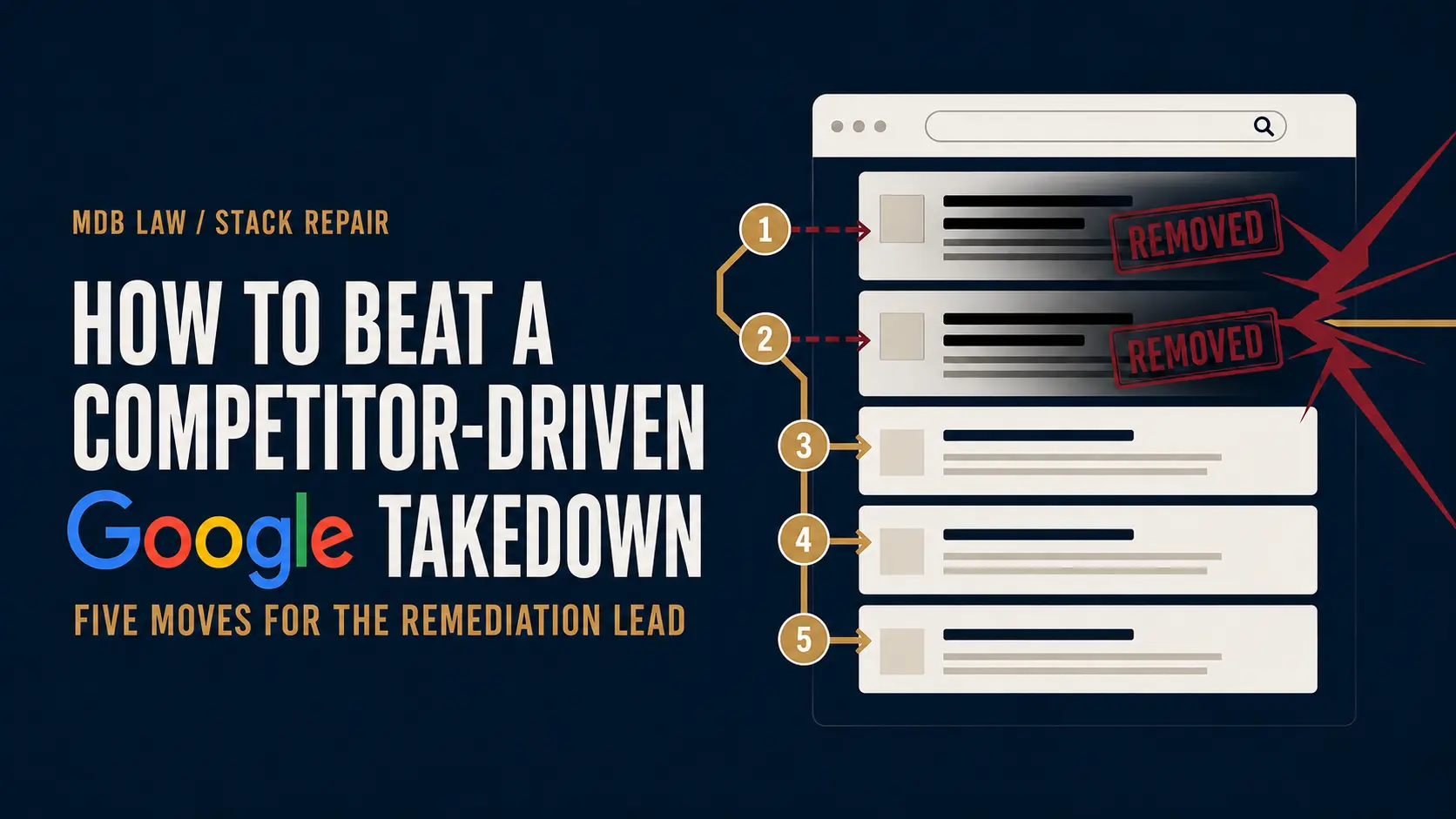
During a recent remediation mandate, an international competitor filed a Google delisting (DMCA Takedown) to remove more than 50 URLs belonging to my paytech client. The website remained “live” but key customer routes had been restricted or removed pending the DMCA outcome.
Commercially, it looked like one major Google-product takedown. At a technical level, however, client faced separate Google interventions requiring different evidence, response procedures and reinstatement routes.
For those of you on the frontline of remediation, here are a few practical lessons and pitfalls to avoid when working to restore affected URLs and content across Google’s platforms.
01 / Identify the Google product
Do not respond to “Google” as if it was one decision-maker.
Identify every affected product, URL, advertisement, campaign or account indicated in the DMCA Notice. Record Google references, restrictive measures, time periods and available review routes.
02 / Freeze the evidence before changing anything
Save the Google notices and take dated screenshots of affected URLs, Search results, Ads account and any Lumen record. Keep the relevant website records, technical logs and provider communications in one controlled evidence file.
Reproduce the journey described in the complaint before changing pages, advertisements or technical rules. Test what a direct visitor and a Google visitor actually see including the relevant device, location and customer journey.
03 / Break the attack down item by item
Build one response schedule matching every affected URL, advertisement or product to the relevant Google reference, allegation, factual answer and supporting evidence.
Separate the items you can prove from those requiring correction or further investigation. For delisting matters, make sure you select the correct reinstatement category and fully motivate your ownership or lawful use options. For Ads or policy matters, identify the exact policy and affected advertisement or destination.
If the record shows repetitive, coordinated or clearly baseless reporting, prepare a short abuse schedule and ask Google to consider the competitor's reporting pattern under its Misuse Policy.
Google Misuse Policy ↗For copyright matters: 17 U.S.C. section 512(f) ↗
04 / File a surgical response—not one mega-appeal
Use the correct live route (forum) for every Google counter-notice. File copyright counter-notices under the relevant Search references while Ads restrictions and account measures must be challenged through their own notices and Policy Manager routes.
Before filing, complete a full dry run of the electronic form. Your signatory, URLs, Google references, factual version, technical evidence and rights position must all reconcile before you send it away. Take note, a copyright counter-notice is signed under penalty of perjury, accepts the specified United States jurisdiction and is forwarded to the complainant.
Submit only what Google needs. Preserve the complete forensic record privately and do not accidentally disclose source code, customer information, security controls, unredacted logs or the full defence strategy.
05 / Drive the matter through to verified reinstatement
Calculate the counter-notice period from the date of Google’s acceptance and forwarding of the notice to the complainant. If the complainant does not notify Google of a court action, press for restoration of your content within the statutory window and verify every affected URL individually.
17 U.S.C. section 512(g)(2)(C) ↗
Remember: there is no single reinstatement clock across Google. Search, Ads and account restrictions must each be monitored until the relevant URL, advertisement, campaign or account is actually restored. Record partial restoration, continuing restrictions and any new policy reason raised by Google.
Field tips for the remediation lead
- Dry-run. Complete the Google form offline before your authorised signatory files the live submission.
- Assume the competitor is watching. The complainant (competitor) may already be monitoring your Search results, advertisements, mobile journeys, redirects and public filings. Any rushed change can become its next exhibit in the subsequent court process.
- Write as though the response may become public. Google forwards a copyright counter-notice to the complainant and legal-removal notices may enter the Lumen record. Your Google version must therefore align with any later legal battle and your witnesses may be tested on this version in open court!
- Use minimum necessary disclosure. It is best practice to ground your formal representations to Google with reference to actually tested exhibits. However, be cautious not to disclose source code, security architecture, customer data which will be shared with your competitor. I would advise to incorporate a tiered disclosure schedule > Tier 1 for counter-notice > Tier 2 producible exhibits to Google on request and > Tier 3 confidential exhibits (i.e. WAF Logs, secret files etc).
- Do not place your entire Google-facing business in one basket. Always keep clear ownership, approval and evidence records for transactional pages, informational content, Q&As, provider material and advertising destinations. One weak or forgotten URL should never be allowed to bring down the entire house.
MDB Law Field Note | General operational information, not legal advice